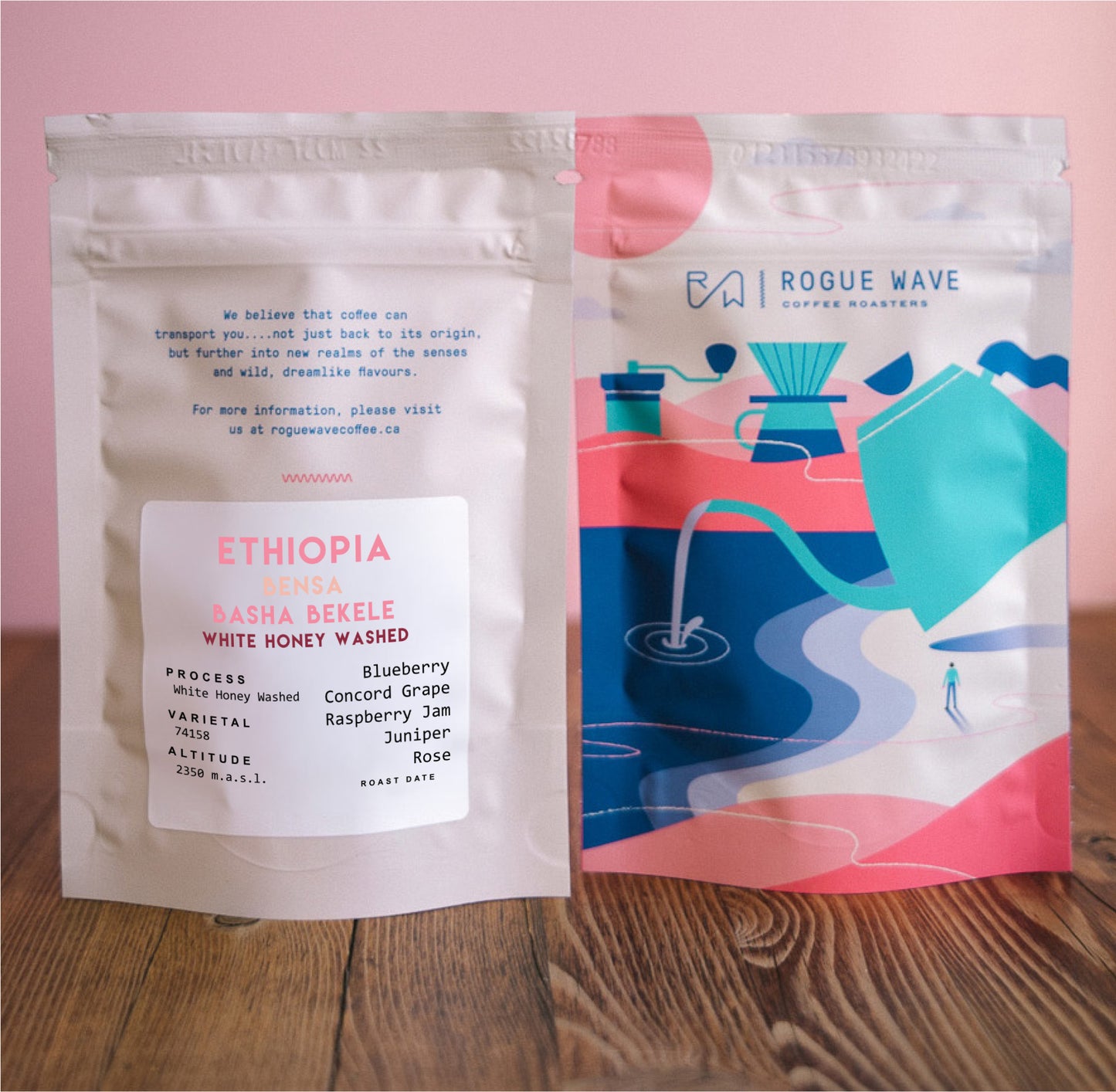





Basha Bekele has been involved with coffee since childhood, growing up with his family’s coffee traditions. He inherited his farm from his grandfather and has been dedicated to producing high-quality coffee since 2018. In 2019, he joined the Buriso Small Farming Group and began exploring export opportunities. By 2022, Basha decided to form his own group, known as Basha Group, comprising a few small farmers. As one of the younger members, he embraced technology, using platforms like Facebook and Telegram to learn about coffee and apply best practices in his processing work.
Like most smallholders around Bensa, Basha almost exclusively produces dry processes—which includes experiments with anaerobic styles of fermentation—and practices cherry flotation before drying his coffee slowly on raised beds (with some preparations drying under shade). But is branching out into semi-washed styles like this wonderful White Honey Washed lot.
Basha’s father—also a community man who with Basha built a church for the community at their site in Bombe—was once a manager for a co-op in Bombe that supplied coffee to the Sidama Union. Before the government made it possible for smallholders to obtain export licenses, both he and his father sold their cherry to the cooperative. Basha now has his own export license and grows coffee (primarily 74158, known locally as “Walega”) in semi-forested plots on 12 hectares in addition to operating collection sites in Bombe, Shantawane, and Kokose—collecting cherry from producers growing coffee as high as 2300 masl.
While cherry prices were high this year, Basha maintained a practice we didn’t see everywhere: delivering a second payment to the 126 producers he bought cherry from once the coffee sold.
Recommendation:
Rest time: 3 weeks
Espresso: 1:2.4-2.6, 93c
Filter: 1:16-1:17, 92-94c